00 Cover
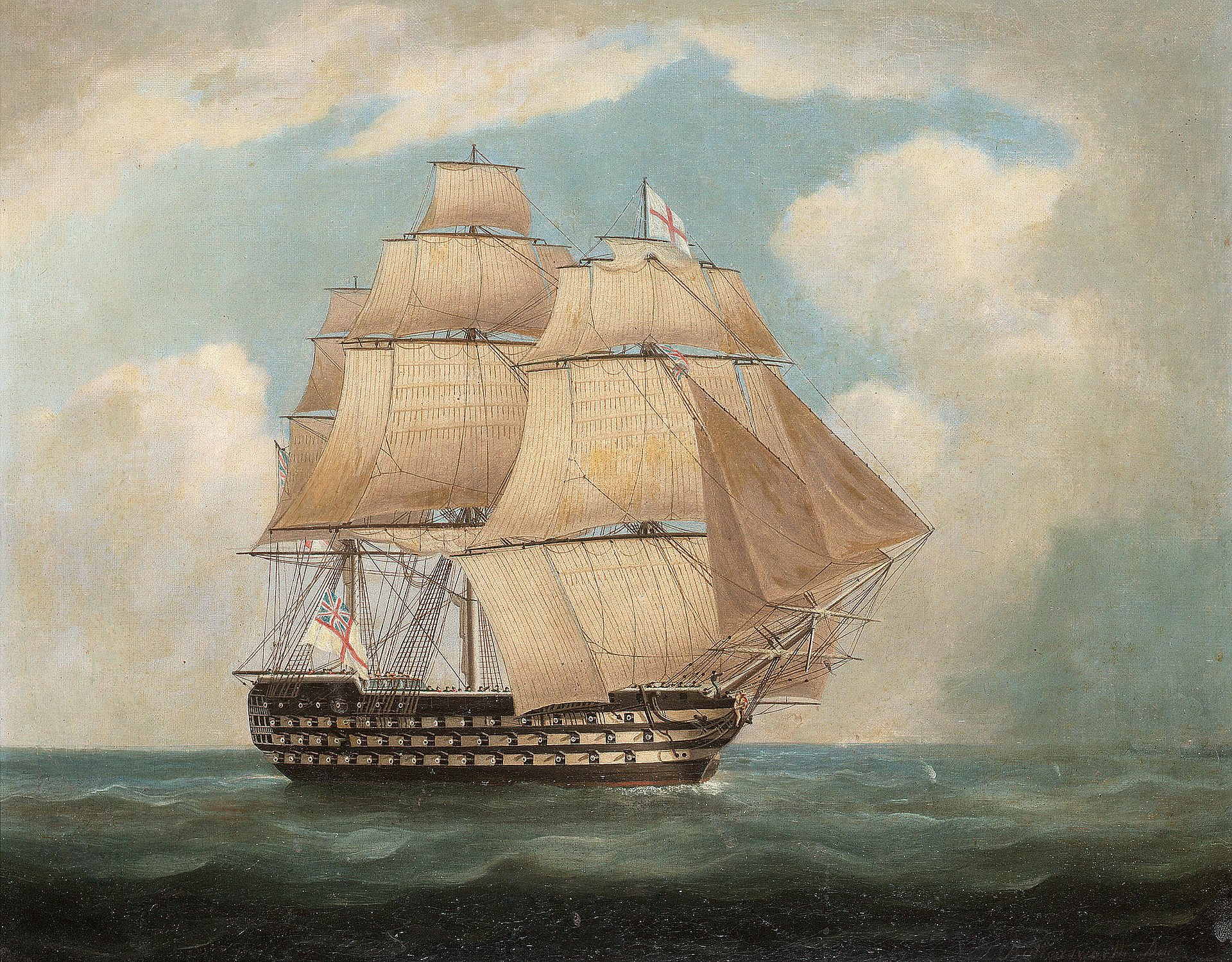
Thomas Buttersworth's painting of HMS Victory under full sail in a squall

Thomas Buttersworth, H.M.S. Victory in full sail and in a squall. Oil on canvas, public domain.

Portsmouth Historic Dockyard  ·  First Rate  ·  Launched 1765

HMS Victory

A Legendary Ship of the Royal Navy

Launched at Chatham in 1765 and still afloat at Portsmouth, HMS Victory is the most famous survivor of the age of fighting sail. A first-rate ship of the line mounting more than a hundred guns, she was already forty years old when Vice-Admiral Lord Nelson raised his flag aboard her and led the British fleet into battle off Cape Trafalgar on 21 October 1805.

Laid down 1759, launched 1765, still afloat at Portsmouth: Nelson's flagship at Trafalgar.

Launched
7 May 1765
Guns
104
Gun deck
186 ft · 56.7 m
Trafalgar
21 October 1805
01 — The Ship

A First Rate Built to Last

HMS Victory was ordered in 1758 and laid down at Chatham Dockyard on 23 July 1759 to the design of Sir Thomas Slade, Surveyor of the Navy. She was the fifth ship to carry the name, and she belongs to the most powerful class of warship the eighteenth-century Royal Navy built: the first rate, of a hundred guns and upwards. Her hull was constructed from thousands of seasoned oak trees, and the work went slowly — the Seven Years' War kept the dockyards busy with repairs, and timber of the required size was hard to find. She was launched on 7 May 1765.

Peace returned before she was needed. Victory lay in ordinary for more than a decade, her guns stored ashore, before the American War of Independence brought her into service in 1778. Over the following quarter-century she carried the flags of admirals in the Channel, at Gibraltar and in the Mediterranean, fought at Cape St Vincent in 1797, and was rebuilt at Chatham between 1798 and 1803.

Nelson took her as his flagship in 1803. Two years later she became, in the space of a single afternoon, the most famous warship in the world. Since 1922 she has rested in dry dock No. 2 at Portsmouth, still a commissioned ship of the Royal Navy, and still — in the words used of her at Trafalgar — in the service of the nation.
01
104guns
Rated armament

A first rate. The actual number of guns mounted varied from year to year.

02
186ft · 56.7 m
Length on the gun deck

Overall length including the bowsprit and rigging was considerably greater.

03
51ft 10 in · 15.8 m
Beam

Breadth of the hull at its widest point.

04
2,142tons burthen
Tonnage

Builder's measurement, a measure of internal volume — not of weight.

05
3full decks
Gun decks

Lower, middle and upper, with further guns on the quarterdeck and forecastle.

06
1922
Entered dry dock

Moved into No. 2 dry dock at Portsmouth, where she remains today.

Official Name
HMS Victory The fifth Royal Navy ship to bear the name.
Classification
First-rate ship of the line, rated at 104 guns "First rate" was the largest of the six rates into which the Navy classified its ships by gun strength.
Ordered
14 July 1758 Ordered during the Seven Years' War, when a shortage of first rates seemed a serious risk.
Shipyard
Chatham Dockyard, Kent Built in the Old Single Dock, now covered by a modern ship hall.
Designer
Sir Thomas Slade, Surveyor of the Navy
Keel Laid
23 July 1759 Six years on the stocks followed, before launch.
Launched
7 May 1765 Floated out at Chatham after almost six years on the stocks. The recorded build cost was £57,748 1s 7d.
Length (Gun Deck)
186 ft (56.7 m)
Length (Overall)
227 ft 6 in (69.3 m) Measured over the bowsprit and rigging; definitions of overall length differ between sources.
Beam
51 ft 10 in (15.8 m) As built, the breadth was measured at 51 ft 7½ in (15.7 m); most modern notices quote the larger, rounded figure used here.
Draught
28 ft 9 in (8.8 m) Draught varied greatly with loading, ballast and stores, and sources quote measurements taken at different moments in her career.
Displacement
About 3,500 long tons (3,556 tonnes) A modern estimate of the weight of water displaced, and not comparable with the builder's tonnage below.
Depth of Hold
21 ft 6 in (6.55 m)
Tonnage
2,142 tons burthen (builder's measurement) Recorded as 2,142 bm — a measure of internal capacity, not of weight.
Armament at Trafalgar
104 guns in all: 30 × 32-pounder on the lower deck; 28 × 24-pounder on the middle deck; 30 × short 12-pounder on the upper deck; 12 × 12-pounder on the quarterdeck; 2 × 12-pounder and 2 × 68-pounder carronades on the forecastle The gun establishment was revised repeatedly; the figures for 1805 differ substantially from those of her earlier career.
Gun Decks
Three complete gun decks Lower, middle and upper decks, with additional guns on the quarterdeck and forecastle.
Crew Complement
About 850 officers, men and boys The National Museum of the Royal Navy records 821 men aboard at Trafalgar, of whom 51 were killed and 91 wounded. Strength depended on the ship's role and establishment.
Masts and Rigging
Three masts — fore, main and mizzen — on a full ship rig Square-rigged on all three masts, with a fore-and-aft spanker on the mizzen. The mainmast truck stood about 205 ft (62.5 m) above the waterline.
Propulsion
Sail only — about 6,510 square yards (5,443 m²) of canvas on a full-rigged ship No steam machinery was ever fitted; the ship was never converted.
Maximum Speed
Up to about 11 knots (20 km/h) under sail Recorded in favourable conditions; normal passage-making speeds were far lower.
Commissioned
1778 First commissioned for the American War of Independence.
Current Status
Permanently dry-docked at Portsmouth Historic Dockyard A commissioned ship of the Royal Navy, flagship of the First Sea Lord, and the oldest warship in the world still in commission.
Notes on the figures

Eighteenth-century dockyard accounts were not kept for the convenience of later historians. Where published sources disagree, this exhibition says which figure it uses.

  • Tonnage. The standard figure is 2,142 tons burthen, but contemporary dockyard records give 2,162 53/94 tons. Both are Builder's Old Measurement — a calculation of internal volume, not a weight. This site quotes 2,142 bm and gives displacement separately at about 3,500 long tons.
  • Guns. She is a 104-gun ship, yet she is also called a 100-gun first rate, and some accounts list 102. The 104 refers to the armament actually mounted at Trafalgar; no single total is correct for every year of her career.
  • Length. The gun deck measured 186 ft (56.7 m), the keel 152 ft 6½ in (46.5 m), and the overall length over the spars 227 ft 6 in (69.3 m). Quoting one of these as "her length" is misleading, so both the gun-deck and the overall figures are given and labelled.
  • Draught. 28 ft 9 in (8.8 m) is the figure most often repeated today; some references give values nearer 26 ft. No original measurement settles the question, and draught changed with loading, stores and ballast.
  • Beam. The as-built breadth was recorded as 51 ft 7½ in (15.7 m); modern notices quote 51 ft 10 in (15.8 m). The difference is small but it is not a rounding error, and this site uses the widely published larger figure.
  • Casualties. Royal Museums Greenwich gives 449 British killed and 1,217 wounded; Wikipedia, following Adkin, gives 458 killed and 1,208 wounded. Enemy losses are counted in the same way: 17 ships taken and one destroyed at Trafalgar, but 21 if the four that escaped and were taken weeks later are included.
Naval terms explained

A warship powerful enough to take its place in the line of battle — the main fleet formation — rather than scouting, escorting or raiding.

The largest class of ship of the line, carrying roughly a hundred guns or more on three complete gun decks.

A deck built around a row of cannon. Victory has three complete gun decks, one above the other.

The square opening cut through the ship's side at each gun, closed by a hinged lid called a port lid.

All the guns on one side of a ship fired together — also used to mean the whole side of the ship as a weapon.

A short, light, large-bore gun invented in the 1770s and named after the Carron ironworks in Scotland. Devastating at close range.

An old measure of a ship's internal volume, calculated from length and beam — not a weight. It was used for dockyard and manning purposes.

The raised deck at the forward end of the ship, above the upper gun deck.

The raised deck aft of the mainmast, where the officers directed the ship and the watch was kept.

The lowest deck, below the waterline. It was where cables were stowed and, in action, where the wounded were taken.

The Royal Navy graded its ships from first to sixth rate by the number of guns they carried, which also fixed their manning and command.

The legal seizure of men for naval service — the "press gang". Unpopular, and one of the grievances behind the War of 1812.

02 — Anatomy

Inside a Floating Fortress

A first rate was a machine for delivering fire from three tiers of decks, and a community of some eight hundred men. These are the parts of Victory that still define her.

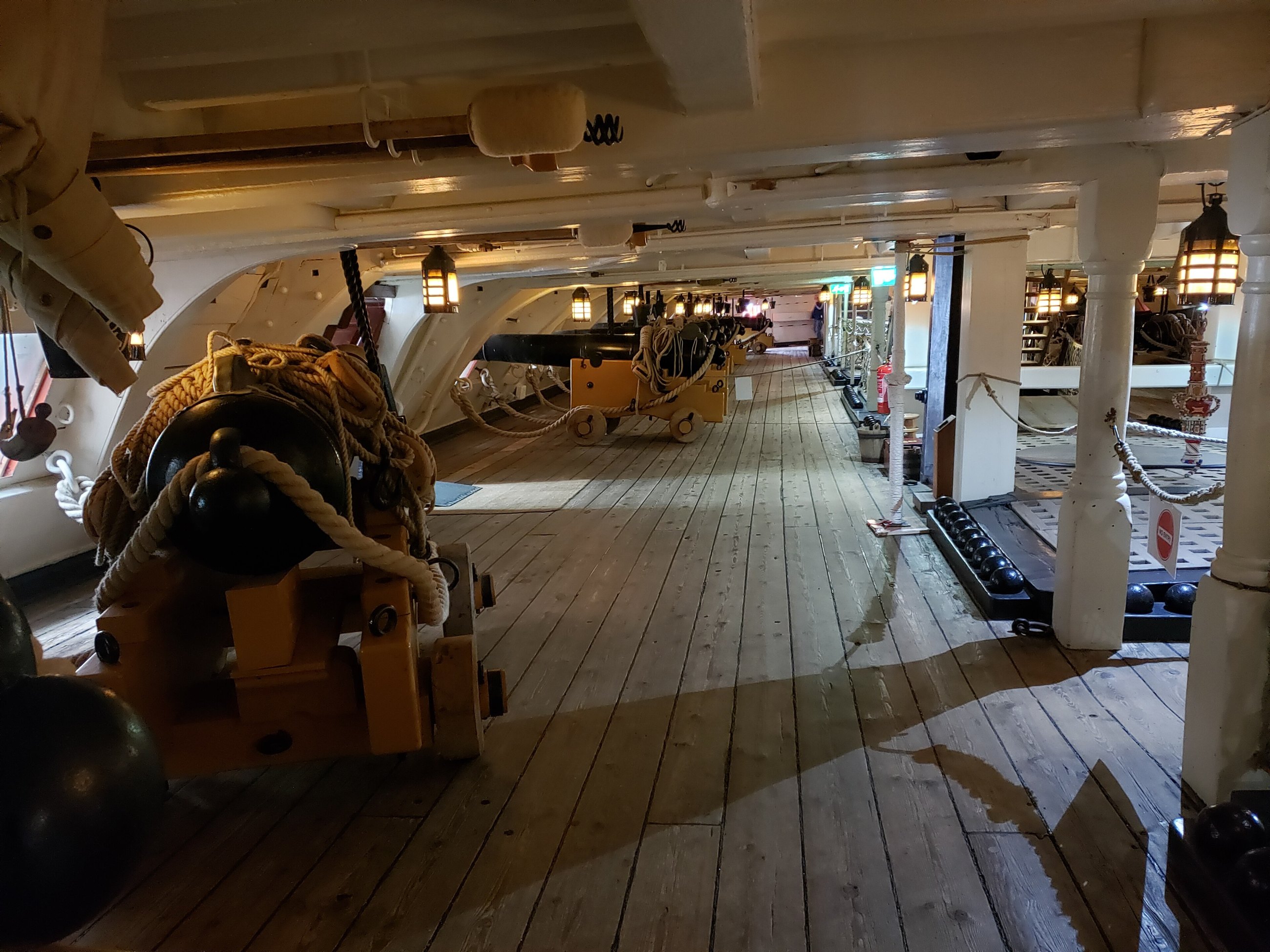
01 Interior of a gun deck on HMS Victory, with cannon mounted at the gunports

Hull and Gun Decks

The hull is a structure of oak frames, beams and planking, 186 feet long on the gun deck. Inside it run three complete gun decks — lower, middle and upper — with the quarterdeck, forecastle and poop above. Each deck is a continuous workspace built around its guns, and the deck beams above each tier are shaped to let the guns recoil.

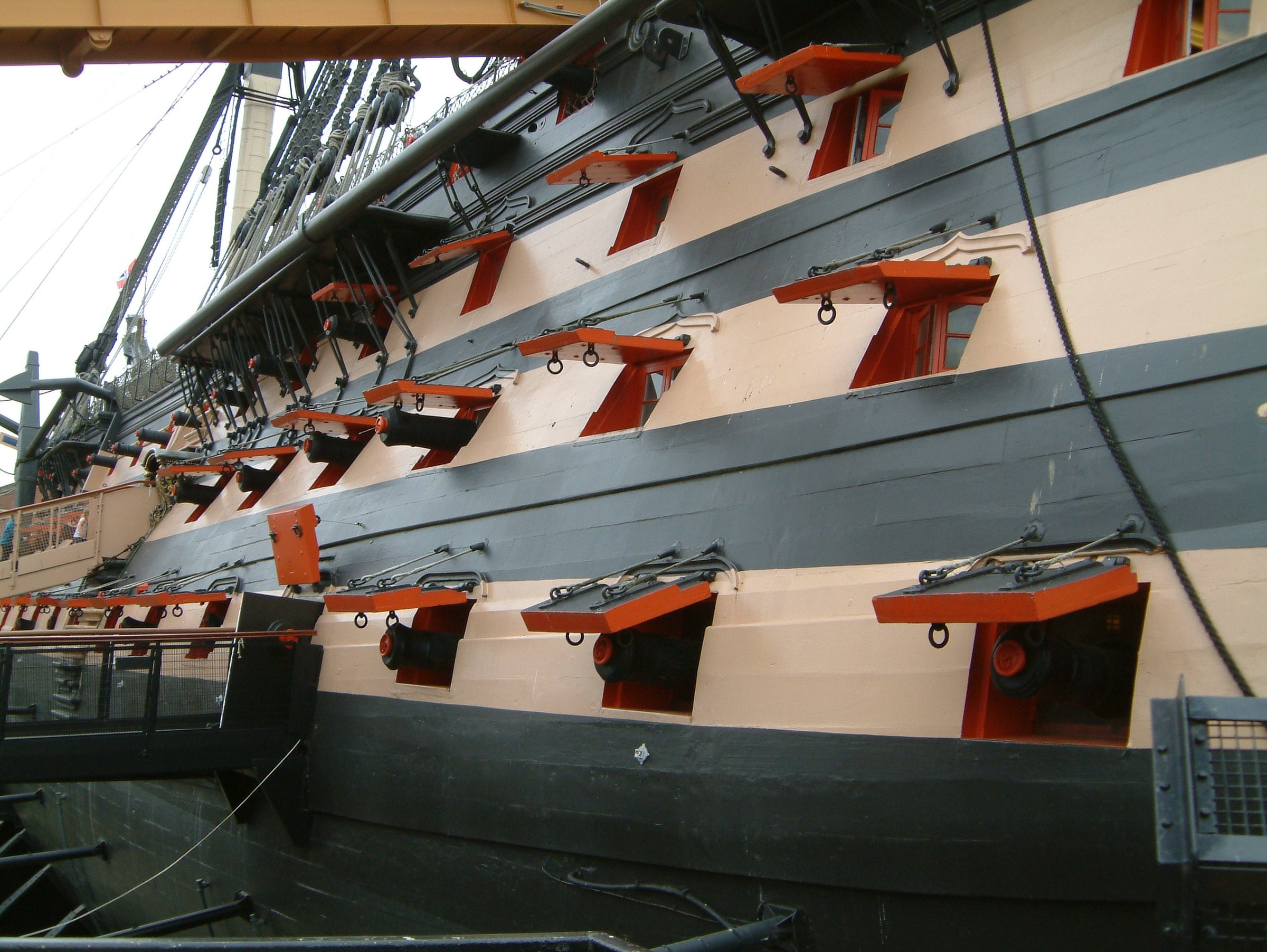
02 A row of gunports along the side of HMS Victory

Naval Artillery

Her main weapons were muzzle-loading iron cannon, mounted on wooden trucks and served by a crew of up to fourteen men. A 32-pounder on the lower deck fired a solid shot weighing thirty-two pounds. Recoil was checked by breeching ropes and gun tackle; in a close action the deciding factor was not accuracy but the rate at which a crew could load and fire.

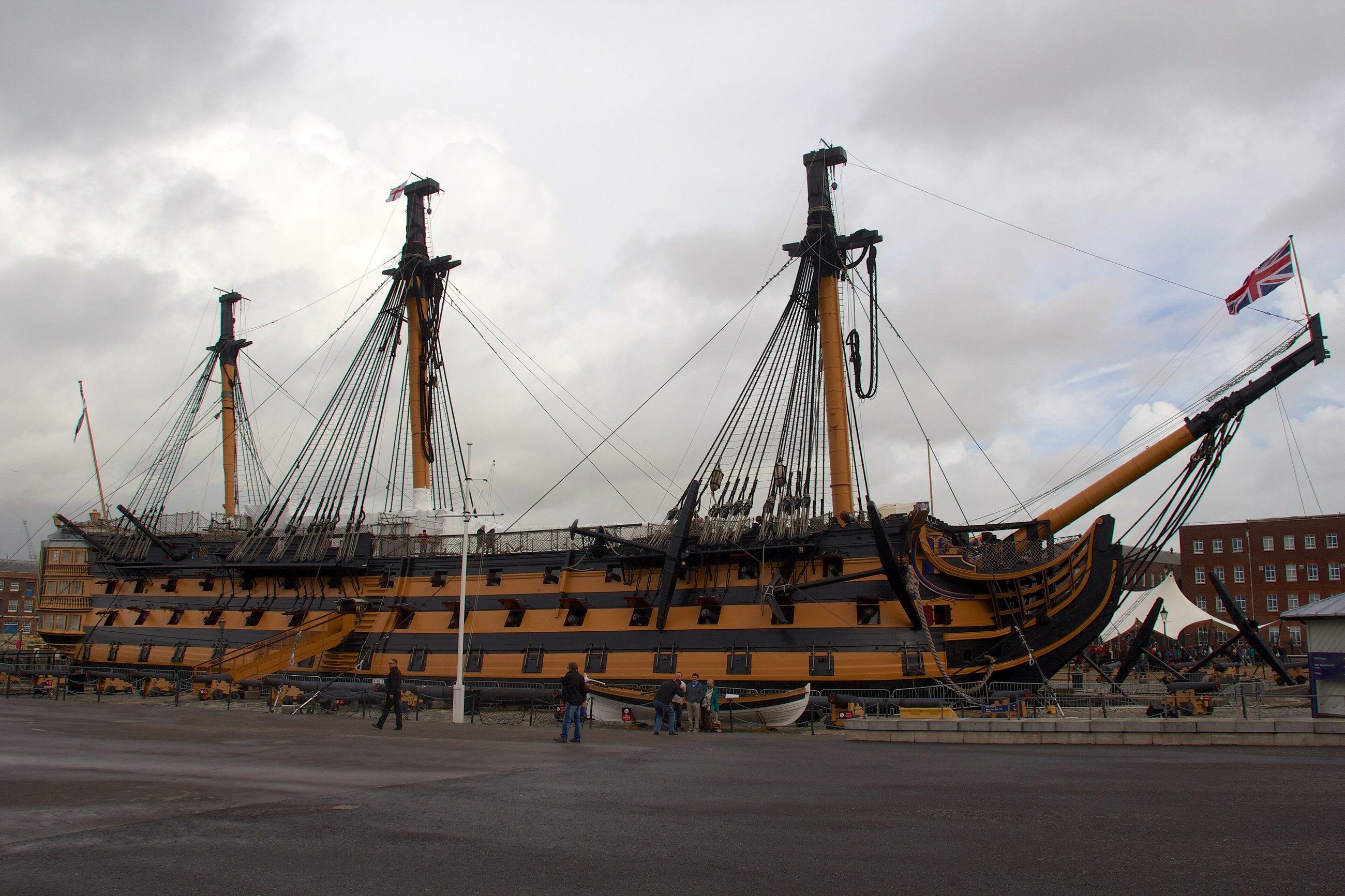
03 The side of HMS Victory showing the regular grid of gunports

Gunports

The square openings along the ship's sides are the gunports, cut at each gun position and closed by hinged lids. In action the lids were hauled up and the guns run out through them. At sea, open ports admitted light and air to crowded decks — and in heavy weather they were a real danger, which is why a careless ship could take water through them.

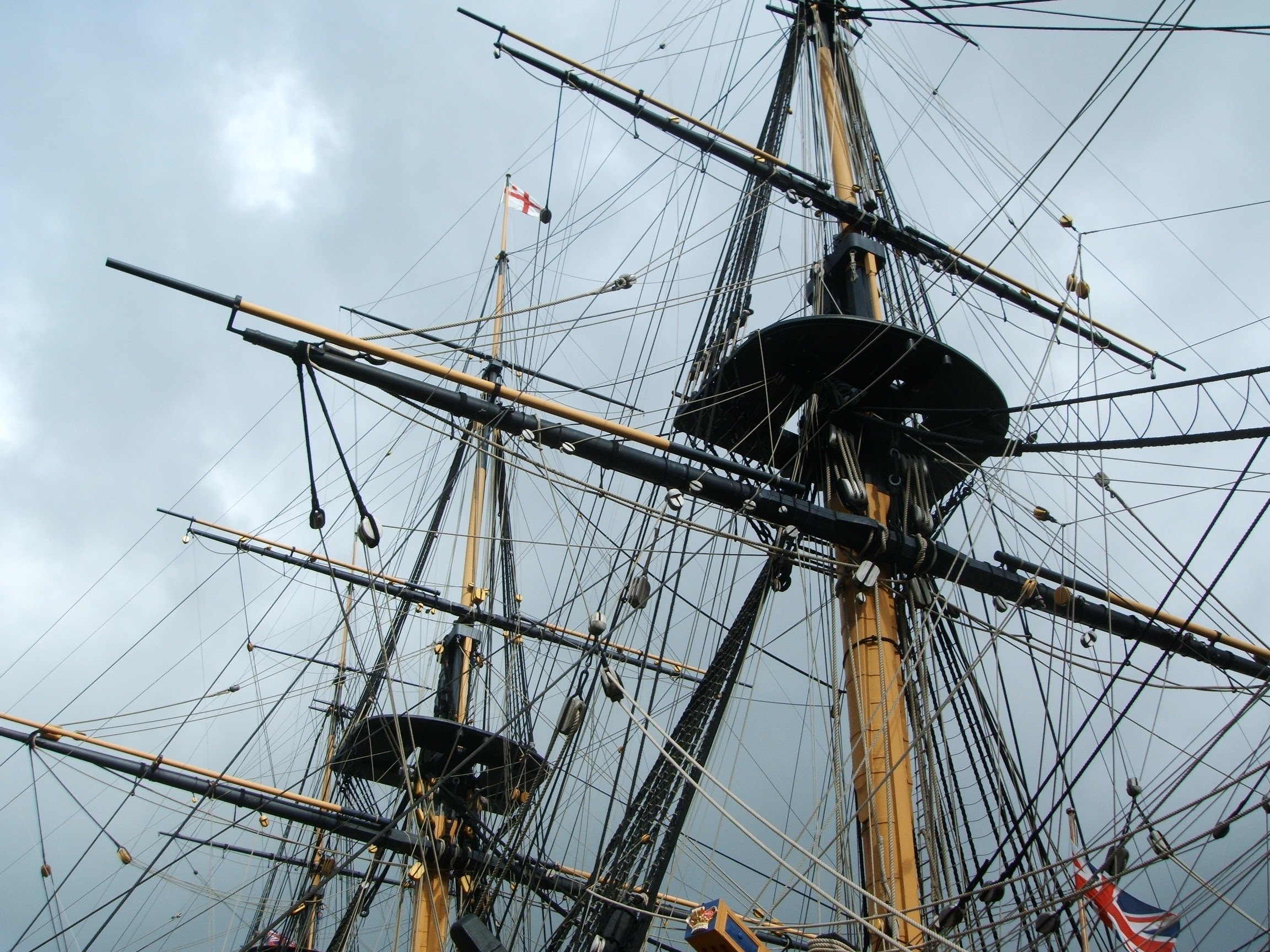
04 The masts, yards and standing rigging of HMS Victory

Masts and Yards

Victory carries a full ship rig on three masts. Fore and main masts are built up from separate spars — lower mast, topmast and topgallant — supported by standing rigging of tarred hemp. Across each mast hang the yards from which the square sails are set, while the mizzen carries a fore-and-aft spanker. The whole structure had to resist enormous load while remaining light enough to sway.

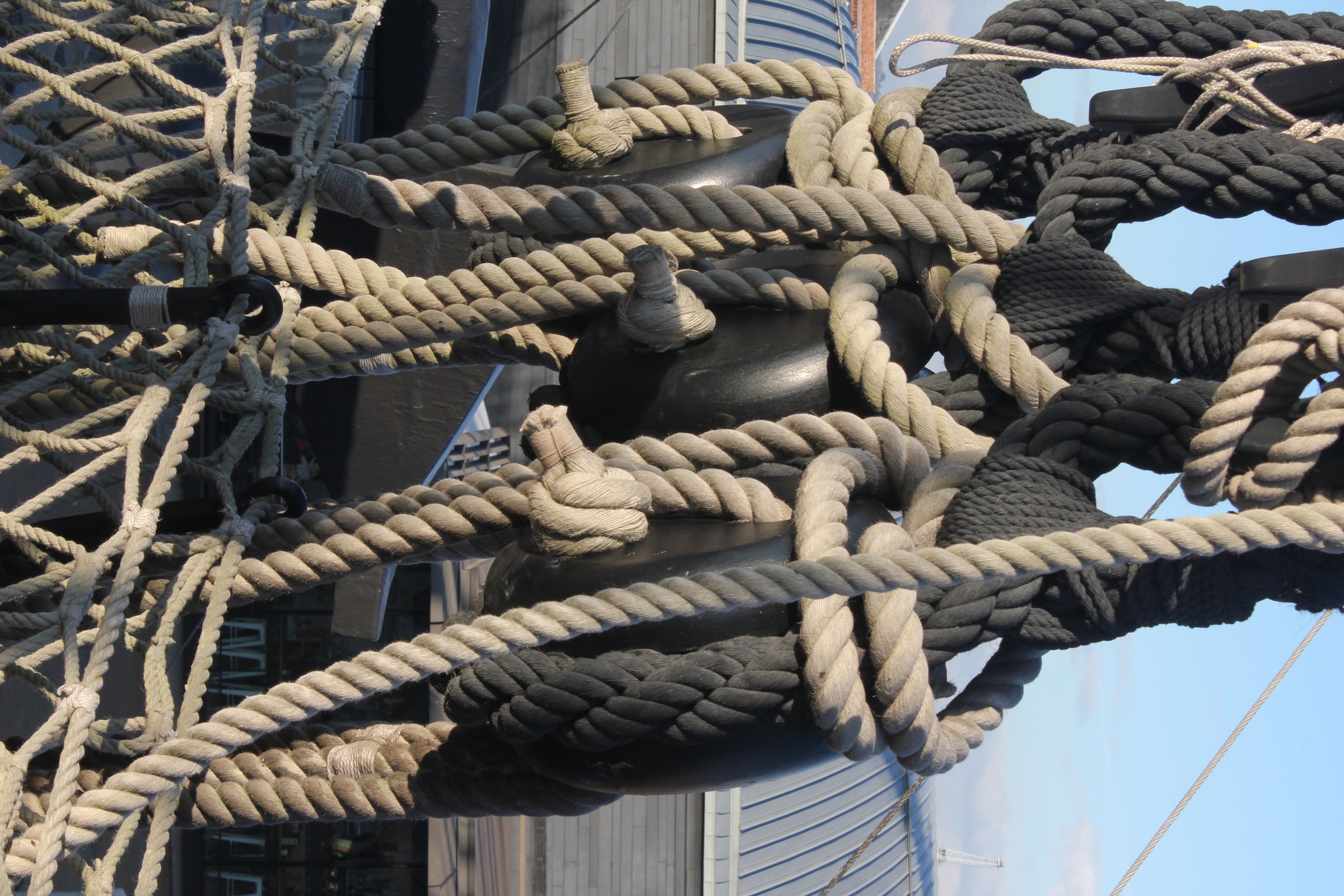
05 Detail of sails, blocks and rigging aboard HMS Victory

Sails and Rigging

Her square sails were made of flax canvas, sewn in panels by sailmakers. Fully spread, the suit of sails covered a very large area and could drive a hull of more than two thousand tons at perhaps ten knots in a strong fair wind. Standing rigging held the masts up; running rigging — miles of rope — worked the sails, led down to the decks where the crew handled them in teams.

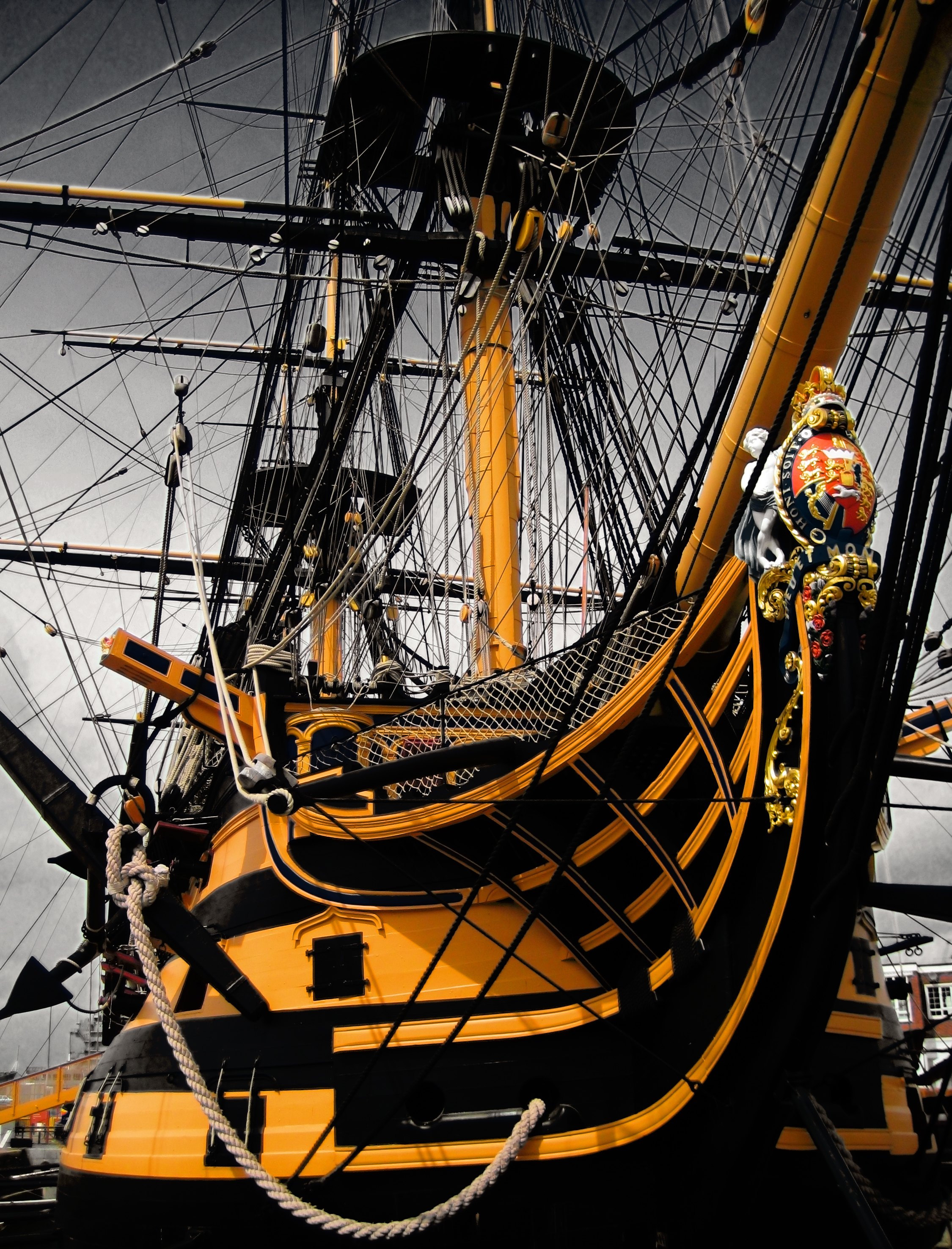
06 The bow and figurehead of HMS Victory

Bow and Figurehead

The bow takes the sea first and carries the figurehead beneath the bowsprit. Victory's present figurehead is a later replacement, and the carvings along the head rails are restorations; decoration of this kind was renewed repeatedly across the ship's long life. The bowsprit and its rigging also extend the sailing rig far forward of the hull, which is why overall length is much greater than the length of the gun deck.

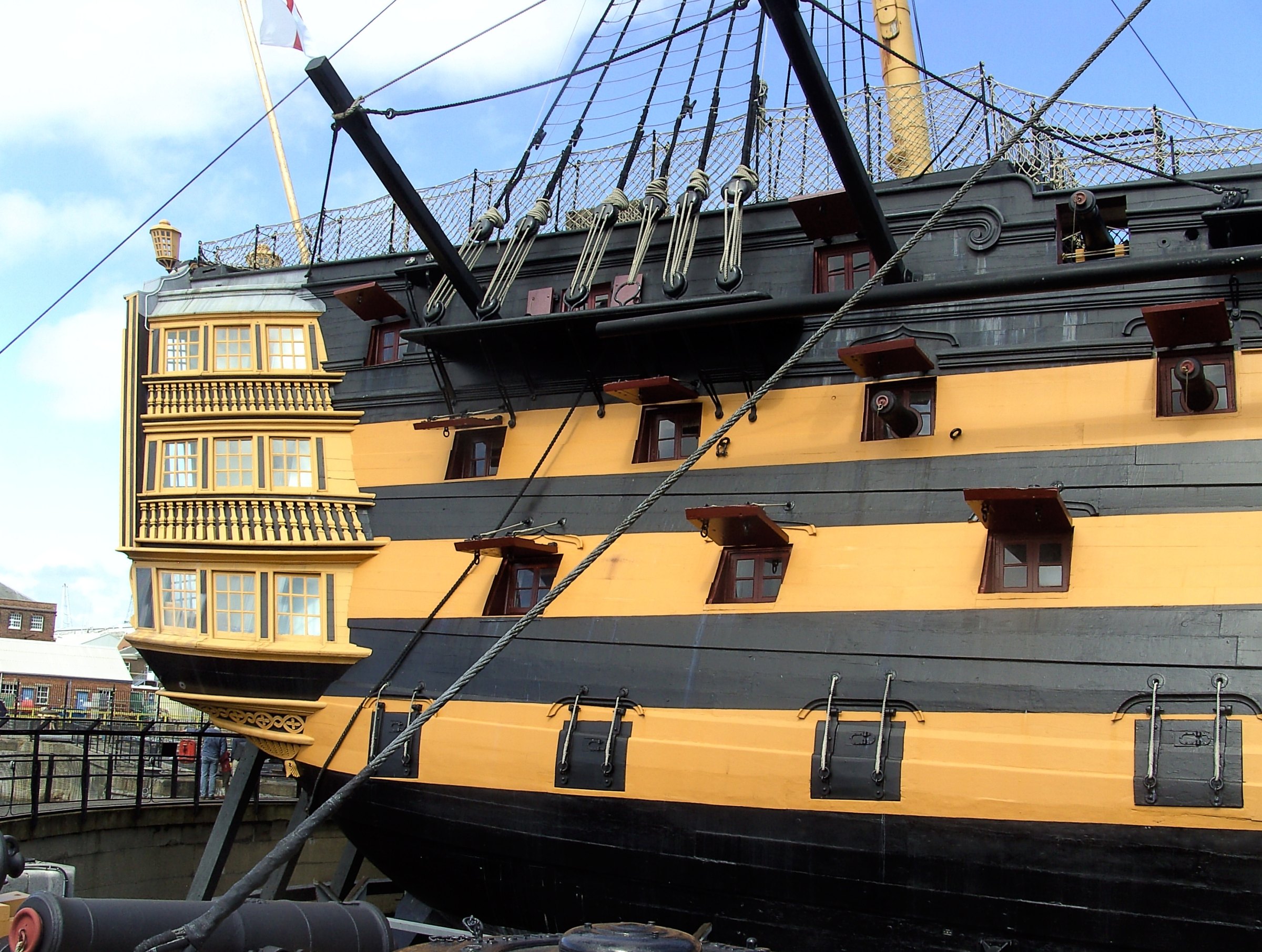
07 The stern galleries and windows of HMS Victory

Stern Galleries

The stern was the most decorated part of an eighteenth-century warship: it carried the ship's name, carving and a range of windows. Victory's stern galleries gave the admiral and captain light and space, and they remain among the most photographed details of the ship. The flat transom is also a structural challenge — it faces following seas and must be both strong and ornamental.

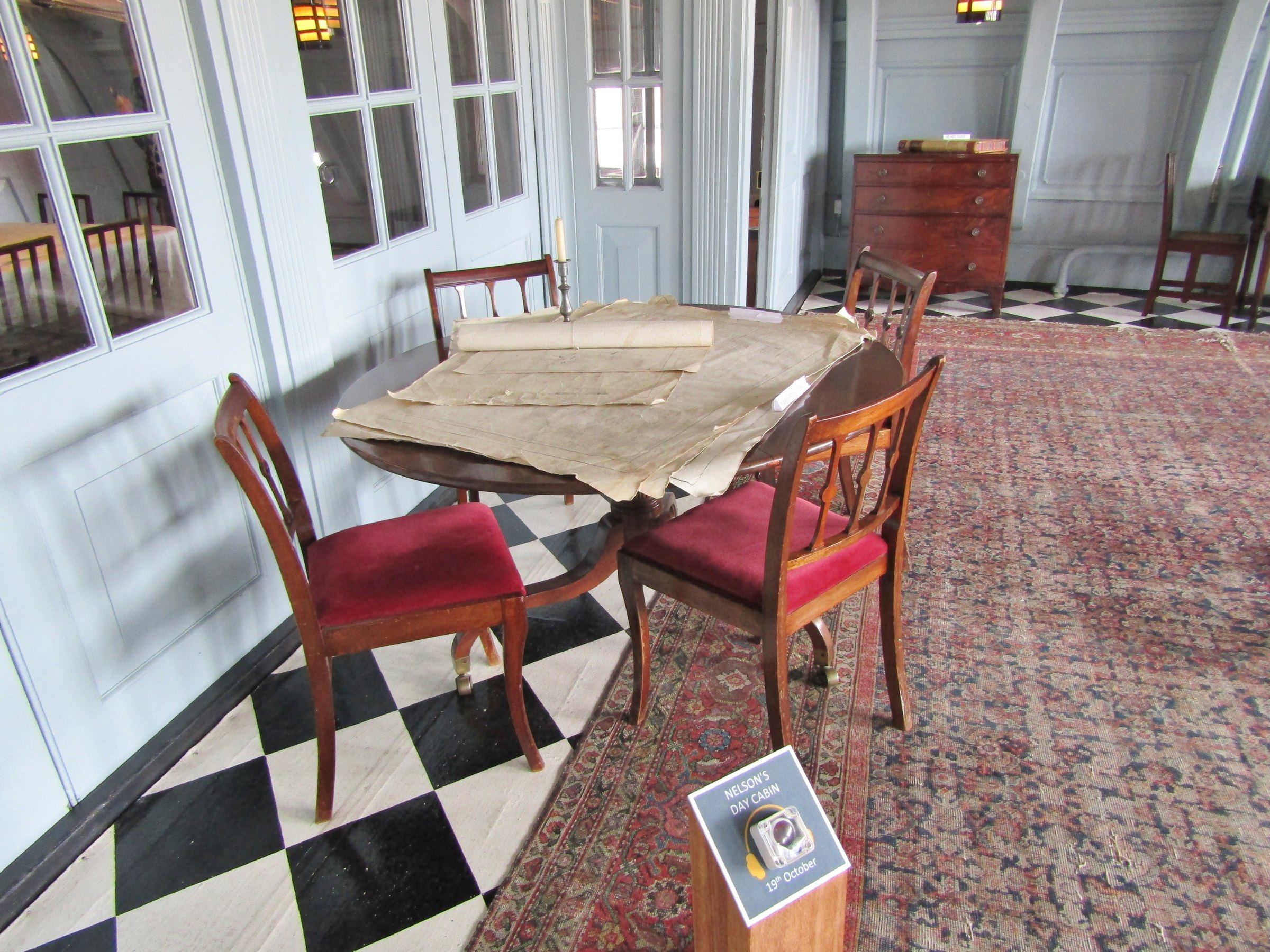
08 A deck and cabin space aboard HMS Victory

Shipboard Navigation and Sailing

Officers navigated by dead reckoning, checked with the lead line and, when the sky allowed, by observation of the sun; latitude came from the noon sight, and longitude from chronometers or lunar distances. Sailing a square-rigged ship was a collective skill. Orders passed from the quarterdeck and the crew handled hundreds of ropes to brace the yards and trim the sails to a wind no square-rigger could sail close to.

03 — Timeline

Two Hundred and Sixty Years Afloat

From a dockyard order in 1758 to a dry dock in the twenty-first century: the dates that define the ship.

1759
23 July 1759

The Beginning of Construction

The Admiralty had ordered a new first rate in 1758, and her keel was laid at Chatham Dockyard on 23 July 1759 to the design of Sir Thomas Slade. Work then slowed almost to a standstill. Britain was at war with France, the dockyards were consumed by repairs and new construction, and seasoned oak of the required scantlings was scarce. The hull stood on the stocks for nearly six years, its timbers slowly drying — an enforced delay that left the frame unusually well seasoned.

1765
HMS Victory seen from the dockside
7 May 1765

Launch of HMS Victory

She went down the ways at Chatham on 7 May 1765, a 104-gun first rate and one of the largest warships of her day. Peace had returned, so the Navy had no immediate use for her: she was taken into the reserve, her guns and stores put ashore, and left in ordinary at Chatham for more than a decade. Her launch was therefore a beginning without a career — the ship existed, but she did not yet sail as a commissioned man-of-war.

1778
Rigging detail aboard HMS Victory
1778

Entry into Naval Service

War with France, and then Spain, brought her forward. Victory was commissioned in 1778 and took part in the Battle of Ushant on 27 July that year. Later service included the relief of Gibraltar in 1780 and, most notably, the Battle of Cape St Vincent on 14 February 1797, where she flew the flag of Admiral Sir John Jervis. A long rebuild at Chatham, completed in 1803, effectively renewed her lower hull just in time for the war that would make her famous.

1805
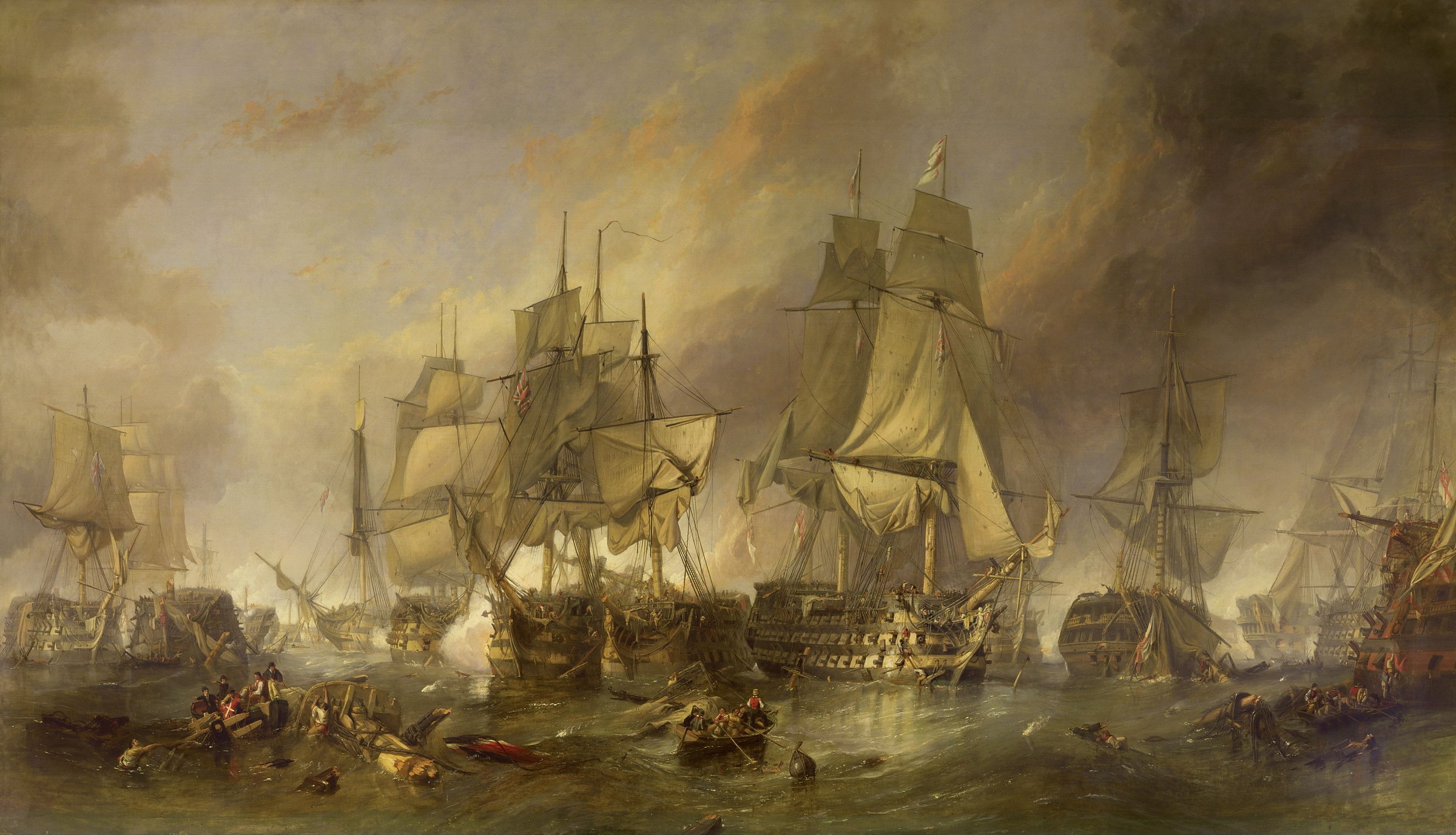
A historical painting of the Battle of Trafalgar
21 October 1805

The Battle of Trafalgar

Victory led the weather column of the British fleet into the combined Franco-Spanish line off Cape Trafalgar. Nelson deliberately broke the enemy formation in two places rather than fight a parallel duel. Victory passed under the stern of the French flagship Bucentaure, raking her with a devastating broadside, and then locked against the Redoutable. The close-range fighting lasted for hours; by evening seventeen enemy ships had been taken and one destroyed, and not a single British ship had been lost.

1805
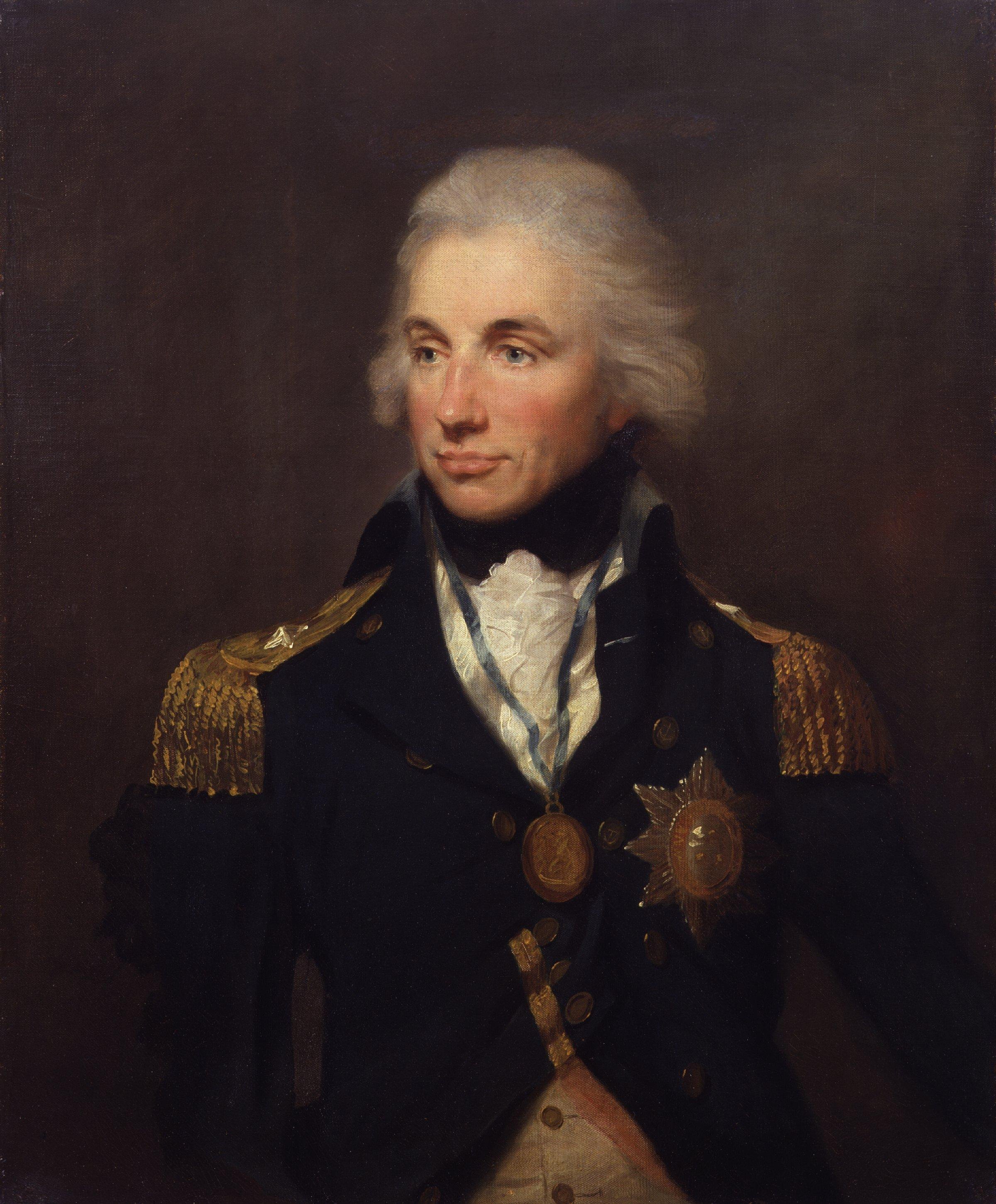
Portrait of Vice-Admiral Horatio Nelson
21 October 1805, afternoon

The Death of Admiral Nelson

At about a quarter past one in the afternoon, with Victory still locked to the Redoutable, a marksman firing from that ship's mizzen top hit Nelson in the left shoulder. He was carried below to the orlop deck, where the surgeon could do little for him. He asked repeatedly for news of the battle, was told that the enemy fleet was being taken, and died at about half past four — some hours before the last guns fell silent.

1922
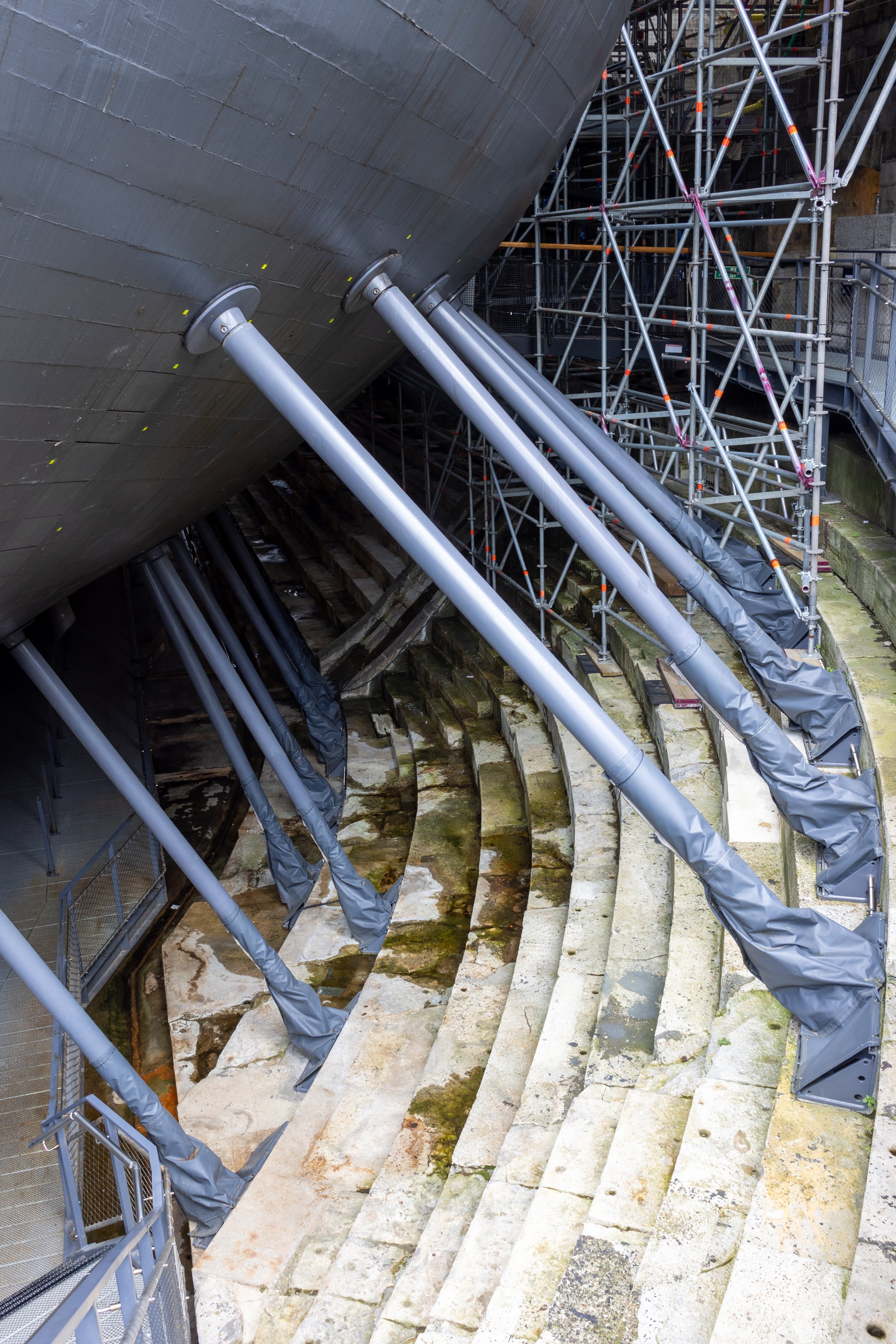
HMS Victory in dry dock during conservation work
1922

The 1920s: Preservation Efforts

By the early twentieth century Victory was a neglected hulk, waterlogged and in real danger of breaking up. A public appeal — the Save the Victory Fund, led by the Society for Nautical Research — raised the money to move her into the newly excavated No. 2 dry dock at Portsmouth, where her hull could be supported and dried out. In 1922 the ship that had been afloat since 1765 came to rest on dry land, and a further restoration followed in 1928, when her stern and much of her internal fitting were rebuilt.

Today
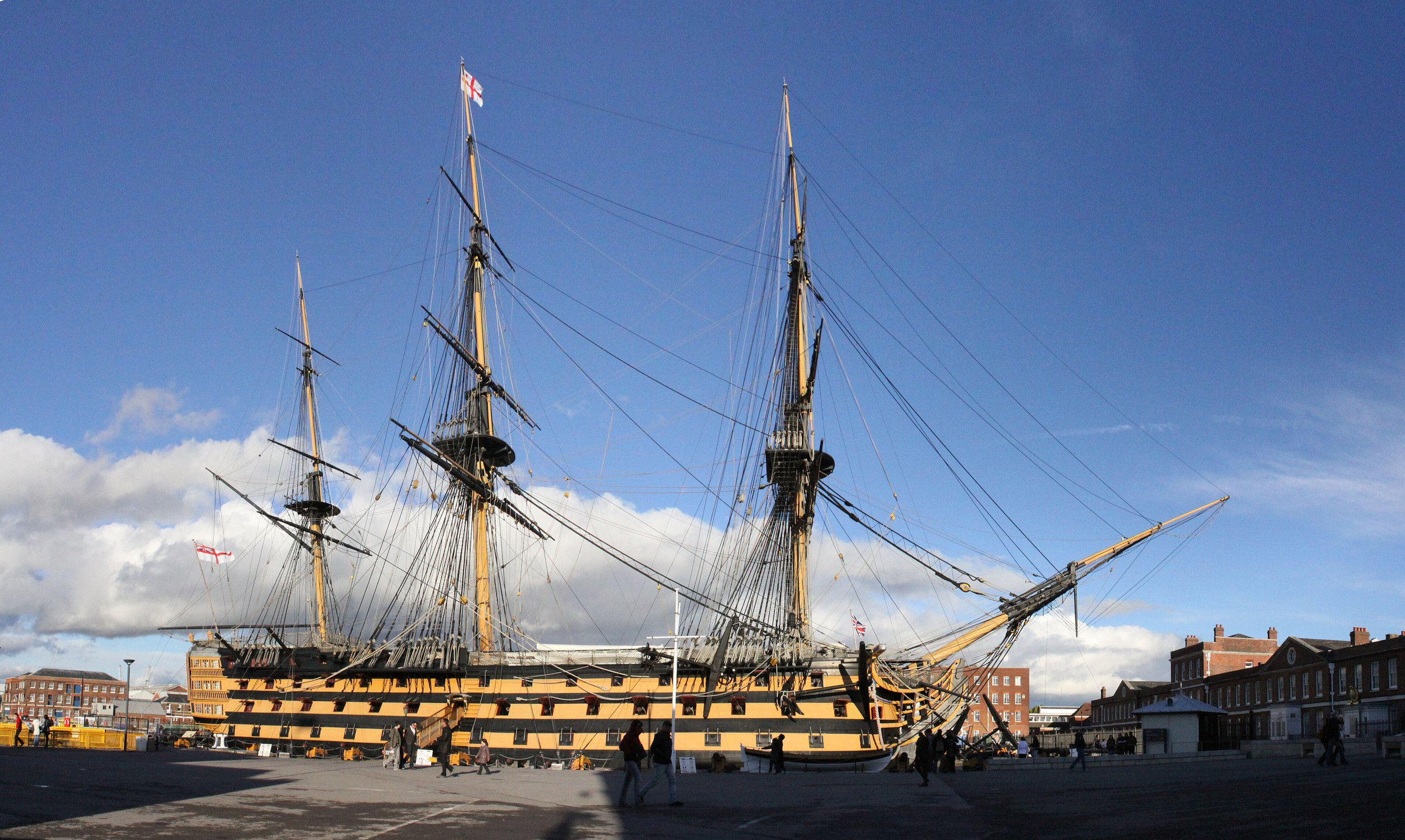
HMS Victory at Portsmouth Historic Dockyard today
Present day

The Modern Era: Conservation and Museum Display

Victory has remained in No. 2 dry dock at Portsmouth ever since, cared for by the National Museum of the Royal Navy. Continuous conservation addresses corrosion, decay and the sheer weight of a wooden hull that will never float again, and in the 2020s the ship entered a long-term programme — the "Big Repair" — to stabilise her hull for the coming decades. She is still a commissioned ship of the Royal Navy and the flagship of the First Sea Lord, and she is regarded as the oldest warship in the world still in commission.

04 — 21 October 1805

Trafalgar

One afternoon off the Spanish coast ended the threat of invasion, destroyed the Franco-Spanish fleet as a fighting force, and killed the admiral who won it.

33Combined ships of the line
27British ships of the line
18Taken or destroyed
0British ships lost
01

Historical Background

By 1805 Napoleon had assembled an army on the Channel coast and needed only a brief command of the sea to invade Britain. The French and Spanish fleets were to combine, draw the British blockading squadrons away and cover the crossing. The combined fleet under Vice-Admiral Pierre-Charles Villeneuve did reach the Atlantic, but it was shadowed, chased and eventually driven south to Cádiz. When it sailed again on 19 October, Nelson was waiting with twenty-seven ships of the line.

02

The Opposing Naval Forces

Villeneuve had thirty-three ships of the line, eighteen French and fifteen Spanish, with a considerable number of frigates and smaller vessels. The British fleet was smaller — twenty-seven ships of the line — but overwhelmingly better trained, its crews kept at sea for years by continuous blockade. The difference in gunnery was decisive: British crews could fire roughly three times as fast as their opponents, and Nelson's plan was designed to bring the fighting to close range as quickly as possible.

03

Admiral Horatio Nelson

Nelson was forty-seven, the most experienced fighting admiral in the fleet, and already a national figure after the Nile and Copenhagen. He had lost an arm and the sight of one eye, and he commanded by inspiring his captains rather than by ordering them — the "band of brothers" he trusted to use their own judgement. His plan at Trafalgar was famously simple and famously dangerous: to sail straight at the enemy line in two columns, accept the raking fire that would come, and then overwhelm the rear of the combined fleet in a close melee.

04

HMS Victory During the Battle

Victory led the weather column, and for the long approach she was under fire without being able to reply. At about noon she cut the enemy line astern of the Bucentaure, firing a double-shotted broadside into the French flagship's stern, and then fell foul of the Redoutable, whose crew tried to board. For most of the afternoon Victory lay locked between enemy ships, her upper decks swept by musket fire and her guns firing at almost point-blank range. Her hull and masts were badly damaged, but she was never taken.

05

Nelson's Fatal Wound

Shortly after a quarter past one, a French marksman in the mizzen top of the Redoutable fired down onto Victory's quarterdeck and hit Nelson in the left shoulder. The ball passed through his chest and lodged in his spine. He was carried below to the orlop, out of sight of the battle he had planned, and lived for another three hours. Told at about half past four that the enemy fleet was being taken, he answered that he was satisfied, and died soon afterwards.

06

The Outcome of the Battle

By late afternoon the combined fleet had ceased to exist as an organised force. Twenty-two of its ships were taken or destroyed — eighteen captured, one burned, three lost — while the British fleet lost no ship at all. British casualties were about 1,700 killed and wounded; French and Spanish losses were far heavier. Villeneuve was captured. A gale in the days that followed wrecked many of the prizes, and Nelson's body was carried home in Victory, preserved in a cask of spirits.

07

Historical Significance

Trafalgar confirmed British naval supremacy for a century and made any French invasion impossible. It also gave the nation a martyr: Nelson's death turned a tactical victory into a founding myth of the Royal Navy. Victory herself became a relic almost immediately — the ship in which the admiral died, preserved first as a hulk, then as a monument, and finally as a museum. The battle is still commemorated every year on 21 October, Trafalgar Day.

Schematic diagram — not a contemporary chart
Schematic of the British attack at Trafalgar The combined Franco-Spanish line runs across the upper part of the diagram. Two British columns, the weather column led by HMS Victory and the lee column led by HMS Royal Sovereign, approach from the south. LIGHT WIND COMBINED FRANCO-SPANISH FLEET · 33 SHIPS OF THE LINE (SHOWN SCHEMATICALLY) WEATHER COLUMN led by HMS VICTORY LEE COLUMN led by HMS ROYAL SOVEREIGN the line is broken in two places

A schematic reconstruction drawn for this exhibition, not a reproduction of a contemporary chart. The combined fleet is shown in line with the two British columns approaching; ship numbers are indicated, not individual positions.

05 — The Age of Sail

The World That Built Her

Victory was not an isolated marvel but the product of an industrial and administrative system. Six short essays on the navy that made her.

The British Royal Navy in the Age of Sail

In the eighteenth century the Royal Navy was Britain's largest industrial organisation: dockyards at Chatham, Portsmouth and Plymouth, thousands of acres of timber, and a bureaucracy that could keep fleets at sea for years. Its strategist advantage was blockade — keeping enemy fleets in port so that trade and invasion convoys could not sail.

Manpower was the constraint. A first rate needed some eight hundred men, and the navy could not recruit them voluntarily in wartime. Impressment, bounties and the quota system filled the ships; conditions were harsh, wages stagnant, and the grievances that produced the great mutinies of 1797 were real ones.

The Ship-of-the-Line System

The Royal Navy graded warships from first to sixth rate by the number of guns they carried, and that rating fixed everything else: how many men, what officers, what cost. Only the strongest — roughly fourth rate and above — could stand in the line of battle. A first rate like Victory was the capital ship of its day: expensive, slow, and expected to decide battles.

Line-of-battle tactics were formal and conservative because signals were hard to read and fleets hard to control. Ships formed a line and engaged the enemy line broadside to broadside, each ship matching the one opposite. Nelson's attack at Trafalgar broke every convention — he accepted a period of unanswerable fire in order to break the enemy line and fight a melee.

Naval Artillery and Gun Decks

A ship's guns were its reason for existing. Smoothbore muzzle-loaders threw solid iron shot, and at close range also grape and canister — a hail of smaller projectiles designed to sweep a deck. Firing was slow and dangerous: powder cartridges were handled by boys, and a gun crew worked in a space barely high enough to stand.

Carronades, introduced in the 1770s, were short, light guns of large bore that hit hard at short range and were nicknamed the "smasher". Victory carried two 68-pounder carronades at Trafalgar. Gun crews drilled constantly; speed of loading was the single most valued skill in the fleet.

Sailing Technology and Rigging

A square-rigged ship of the line was a hand-built, hand-worked machine of wood, hemp and canvas. Rope was the technology of the age: standing rigging to hold the masts, running rigging to work the sails, and blocks and tackles to multiply the power of a man's pull. A first rate carried miles of cordage.

Square rig sails best with the wind behind and abeam; it cannot point close to the wind, and a fleet that lost the weather gauge could take days to regain it. This is why wind direction shaped every tactical decision at Trafalgar — and why the approaching British columns travelled so slowly under fire.

Life Aboard a Warship

Eight hundred men lived in a hull 186 feet long, in a space with no privacy and little air. They were divided into watches, slept in hammocks slung between the guns, and ate a diet of salt beef, biscuit, pease and beer. Disease killed far more sailors than enemy fire — until citrus, hygiene and better victualling began to change that.

Discipline was brutal by modern standards: flogging was the standard punishment, and desertion or mutiny could end at the yardarm. Yet shipboard society was also remarkably diverse and skilled — the crew included carpenters, sailmakers, coopers, armourers and a surgeon, all of whom had to work while the ship fought.

The Historical Legacy of HMS Victory

No other warship occupies quite the same place in British memory. Victory is both a technical artefact — a nearly intact first rate of the 1760s — and a shrine to Nelson. She survived because people decided she should: the 1922 campaign, decades of dockyard care, and a continuing conservation programme.

Her survival is also an accident of geology and money: a wooden ship cannot be preserved by doing nothing, and every generation has had to choose to pay for her. Today she is a museum, a commissioned warship, and a reminder that the Royal Navy's century of supremacy rested on ships like this one and the people who sailed them.